

Industry Innovation: Underwater Robots
QUICK LINKS: View all Marine & Boat Building components
Industry Innovation: Underwater Robots
Welcome to our new series of articles, where we’re going to dive into (pun intended) the latest tech industry innovations that we’re getting excited about. And it just so happens that there have been a few interesting developments with underwater robotics recently, so we thought why not start there!
Deep Sea AUVs
Recently in Norway, a brand new robot submarine was launched by the Norwegian Offshore Directorate and Norwegian Marine Data Centre, to map deep-sea regions and gather data about the seabed. This autonomous underwater vehicle (AUV), known as Hugin Superior, is currently regarded as the most capable and advanced AUV in the world.
How does it work?
Hugin Superior was developed to be able to reach depths of up to 6000 meters (or 19,685 feet) and carries a wide array of highly advanced sensors, as well as high-res sonar systems, cameras, laser profilers and the ability to detect natural gases & other substances. It also features an extremely accurate navigation and positioning system, utilising autonomous pipeline tracking, terrain navigation and single beacon underwater transponder protocol navigation. Its autonomous design means that it can stay underwater for long periods of time and works completely independently from its support vessel, which frees it up for other tasks.
Why is it useful?
This AUV is able to survey roughly 4.5 square km² (or 1.74 mi²) per hour, and produces incredibly detailed data, images and bathymetric maps. Having a better understanding of the sea beds surrounding a country can help in efforts to improve ocean habitat sustainability and resilience, to understand the effects of climate change, and to develop models that assess the risks of coastal flooding.
Impostor Jellyfish
At the School of Mechanical and Electrical Engineering of Northwestern Polytechnical University in Xi’an, Shaanxi province, a team led by Tao Kai have created a transparent robot that is able to mimic the appearance and movements of a jellyfish. It is designed to provide intelligent underwater detection with real-time environmental monitoring, and could also be used for covert reconnaissance missions.
The robot is made from a specially developed transparent hydrogel electrode material and has a domed body with flexible tentacles and a fluid propulsion system that allows it to replicate the movement of a real jellyfish. Plus, it measures only 4.7 inches in diameter and weighs 2 ounces, meaning that it is nearly undetectable to sensors or the human eye.

How does it work?
An electrostatic hydraulic actuator is used to propel the robot and only consumes 28.5 milliwatts of power. The actuator functions similarly to the neural signals in living organisms, which means that the jellyfish can move in an organic way, without the noise or vibration typical of other propulsion systems. This allows the robot to remain undetected in sensitive marine environments, where it can observe delicate ecosystems, inspect manmade structures, or even conduct covert underwater missions.
To record data that it collects, the robot is fitted with a tiny camera and an AI processing chip, which allows it to navigate complex environments autonomously, and to detect and identify targets with high precision.
AUKUS Uncrewed Vehicles
In 2021, the Australian, United Kingdom and United States governments entered into a security pact known as AUKUS, to support defense. As part of this alliance, AUKUS is developing technology to create uncrewed undersea vehicles (UUVs). The key benefit of these UUVs is that they can go into areas that manned submarines and underwater vehicles are not able to enter.
Why are UUVs useful?
The AUKUS UUVs will be used for a variety of applications in both military & defense operations, but also for surveillance and protection of underwater infrastructure. In the UK, one large part of these defence initiatives is to protect our large network of underwater pipelines that deliver gas from European countries to the UK, and undersea cables that provide crucial support to our telecommunication and power systems.
Drilling Robot
Another advancement to come out of China is a drilling and real-time monitoring robot that has been developed by the Guangzhou Marine Geological Survey (GMGS), within their Ministry of Natural Resources.
How does it work?
The 2.5m (8.2ft) tall robot weighs 110kg (243lbs) and combines a three-dimensional drilling mechanism with multiple onboard sensors, which enable it to operate within the seabed rather than having to remain on the ocean floor. Its system supports multi-parameter in-situ monitoring at a large scale and for long durations, which allows researchers to collect data from subsurface formations continuously (whilst the robot is active). This is a vast improvement on other monitoring methods that rely on stationary platforms and/or surface-based sampling.
The conditions of the deep sea can be harsh; with extreme pressure, low temperatures, high salinity and unstable geology. To combat this, the robot has been equipped with AI algorithms, inertial navigation systems and magnetic beacon-assisted positioning. This means that it can autonomously plan routes, adapt to changing conditions and maintain precise positioning.
Why is it useful?
During a recent trial of the robot, it was able to capture more than 2000 data sets, including measurements of oxygen and methane levels, as well as subsurface structural information. It is hoped that this kind of data will help to improve understanding of geological conditions in our oceans and will support future deep sea exploration.
Being able to collect data on deep sea strata (layers of rock, sediment, or soil under the sea bed) will also allow researchers and scientists to identify important resources that are believed to be contained within the strata. This includes rare earth elements, natural gas hydrates and polymetallic nodules. Prior to the development of this robot, sustainable and safe exploration of these areas has been limited by a lack of low-disturbance technologies that could record data in real time.

IP Rated Components
The most important feature of any underwater device is that every part of it must be waterproof. Any components, such as switches and indicators, should have a rating of IP68, which is the highest rating for water submersion. IP68 guarantees protection from water ingress up to and including complete submersion below one meter and for more than 30 minutes. For deeper sea devices though, components would need to be further protected via methods such as waterproof membranes, etc.
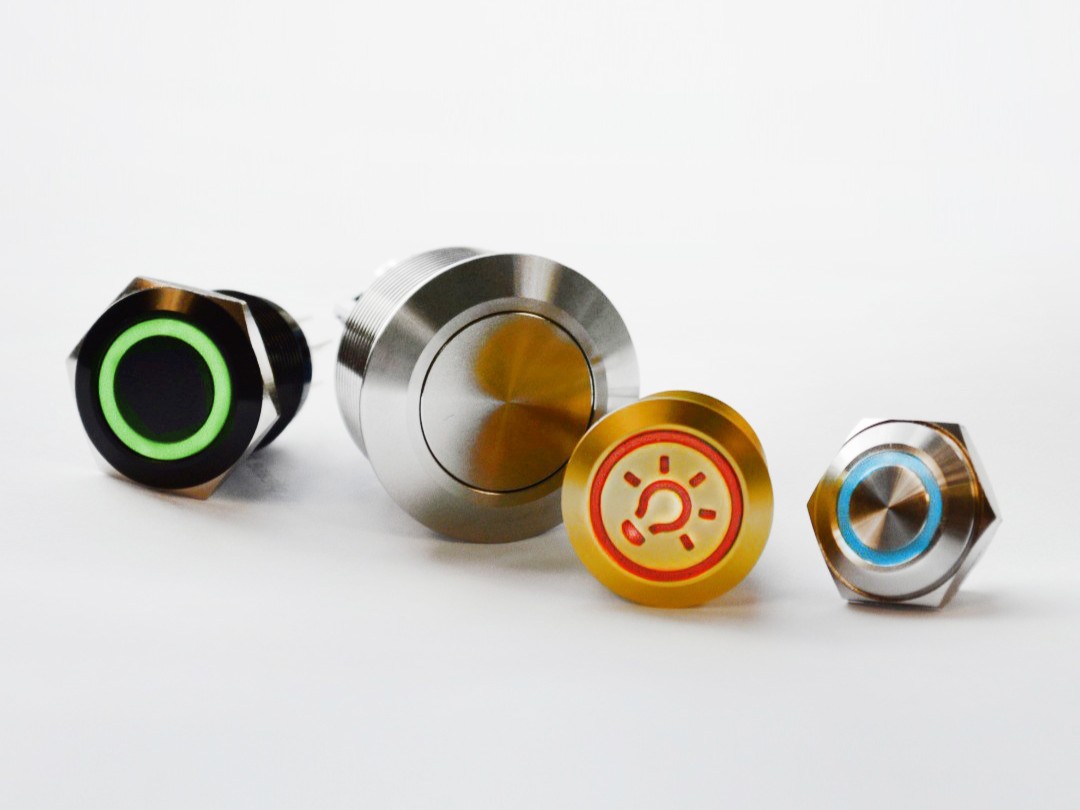
Metal Push Buttons
Our metal push buttons are vandal-resistant and have an IP65 or IP67 rating to protect against water and dust.

LED Indicators
We also offer IP67 rated metal LED indicators to signal system modes or errors, with single or bi-colour illumination.
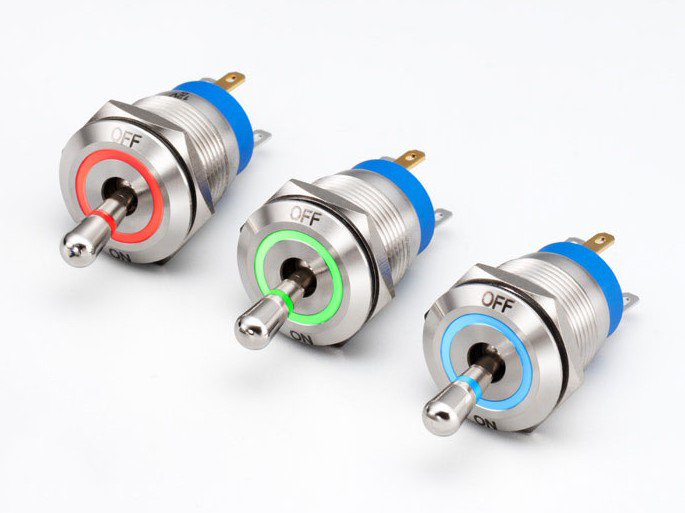
Toggle Switches
A wide range of our toggle switches have an IP65 or IP67 rating, including the RJS-TOG range of anti-vandal toggles.
Summary
Whether it’s researching geological conditions and marine habitats, or creating new military defenses, technology in underwater robotics is only going to continue to advance, and we can’t wait to see what’s next. If you’re interested in our IP rated components or any of our other products, contact our Sales team today to find out more.
Interested in our products? Speak to us today!
How to place an order?
We operate Monday – Thursday (8 am – 5 pm) and Fridays (8 am – 4.30 pm)
Call us on +44 (0) 1234 213600 to speak to our Sales Engineers or e-mail us
on sales@rjselectronics.com alternatively, leave us a message using our online contact form.
View our full product range here | Download our recent product catalogue
Switch on.
Sign up to our mailing list for the latest news, product notification and so much more!
Just one click away…